
The Cullinan Diamond
About the Cullinan Diamond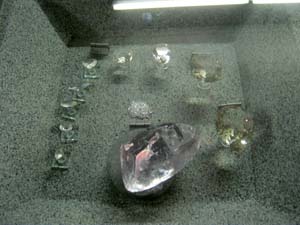
The Cullinan Diamond is the largest rough gem-quality diamond ever found, at 3,106.75 carats (621.35 gram). The largest polished gem from the stone is named the Cullinan I, or the Great Star of Africa. It weighed 530.4 carats. It remained the largest polished diamond in the world, until the discovery of the Golden Jubilee Diamond, also from the Premier Mine, which weighed 545.67 carats.
The second largest gem from the Cullinan diamond, the Cullinan II, or the Lesser Star of Africa, weighs 417.4 carats, and is the fourth largest polished diamond in the world.
Both the Cullinan I and Cullinan II gems are now part of the Crown Jewels of the United Kingdom.
History of the Cullinan Diamond
The Cullinan Diamond was found by Frederick Wells, surface manager
of the Premier Diamond Mining Company in Cullinan, on January 26, 1905. The stone
was named after Sir Thomas Cullinan, the owner of the diamond mine.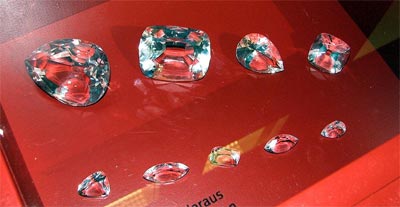
After analysis by Sir William Crookes, is was pointed out that the diamond had remarkable clarity, but that it also had a black spot in the middle. The colors around the black spot were very vivid and changed as the analyzer was turned.
The stone was bought by the Transvaal government, and presented to King Edward VII on his birthday.
The Asscher Brothers of Amsterdam, diamond cutters extraordinaire, was commissioned to cut the Cullinan diamond. The diamond was initially cut into three large parts, and eventually into 9 large gem-quality stones and a number of smaller fragments.
Technology at that time was not yet able to guarantee quality of the modern standard, and cutting the diamond was considered a difficult and risky task. In order to enable Asscher to cut the diamond in one blow, a half and inch deep incision was made.
Using a specially designed knife, the diamond was split in one blow. The diamond split through the defective (black) spot, which was then shared in both halves of the diamond.
 Map of South African Attractions
  South African Attractions with GeoCaches